

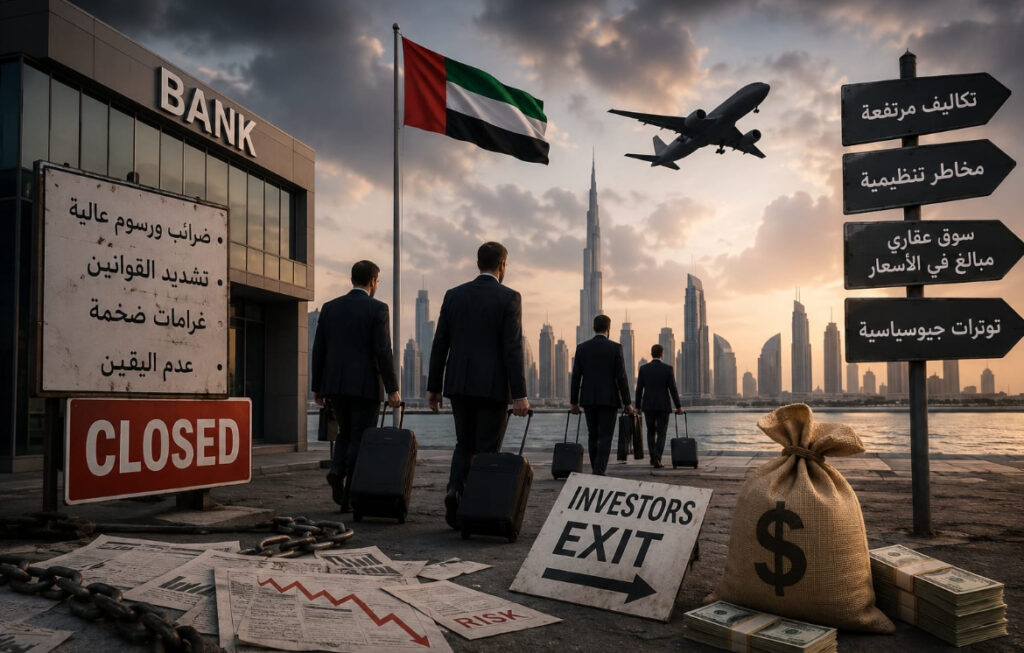
Despite the glamorous image the UAE promotes as a paradise for investment and business, recent years have shown worrying signs of investors leaving and international banks reducing or shutting down operations inside the country. This raises an important question:
Has confidence in the UAE market begun to weaken?
The truth is that every economy in the world, no matter how strong it appears, faces hidden challenges that are not always visible through official media or advertising campaigns. The UAE is no exception.
One of the main reasons that pushed some investors and banks to reconsider their presence in the UAE is the rising cost of operations and increasing government fees, especially after the introduction of new taxes and charges in recent years. This has reduced the market’s attractiveness compared to previous years.
In addition, stricter financial and regulatory laws have led to massive penalties against banks and companies operating in the UAE. The UAE Central Bank announced fines exceeding AED 370 million imposed on banks, exchange companies, and insurance firms during 2025 alone due to compliance and financial transparency violations.
One clear example was the decision of LLB Bank, one of Liechtenstein’s oldest banks, to close its operations in Dubai and Abu Dhabi after many years of activity, citing rising regulatory costs and weak economic feasibility compared to its business size in the UAE.
Another example involved India’s HDFC Bank, which faced a UAE regulatory decision preventing it from onboarding new clients at its Dubai International Financial Centre branch. This created concerns among foreign investors regarding the strict regulatory environment inside the country.
Another major factor is the growing fear of a real estate bubble, especially in Dubai, where some investors believe property prices have risen excessively due to speculation and aggressive marketing rather than genuine and sustainable demand.
Even on investor platforms, warnings have started appearing against purchasing properties based on media hype rather than solid economic foundations, with discussions about areas already suffering from oversupply and the possibility of future market declines.
Geopolitical concerns also cannot be ignored. Tensions in the Gulf and the Middle East push some global investors to search for safer markets that are less exposed to military or political risks.
Despite all this, it does not mean that the UAE economy has collapsed. The country still possesses strong infrastructure and a massive financial sector, while Dubai and Abu Dhabi remain among the most important economic hubs in the region.
However, the clear reality is that the era of “easy investment” may be over, and foreign investors have become far more cautious about injecting money into the UAE market due to changing regulations, increasing risks, and rising operational costs.
The biggest question remains:
Can the UAE maintain its image as a global financial center amid fierce competition and upcoming economic and political challenges?
Journalist Dr. Magdy Kamel ElHawary writes : Why Have Investors and Banks Fled the UAE?
📧 اشترك في النشرة البريدية
أهم الأخبار توصلك على بريدك.




💬 التعليقات (0)